
SEO Specialist Philippines: 9 Essential Checks Before Hiring
An SEO specialist in the Philippines helps a business improve its visibility in Google Search, Google Maps, and AI-powered search experiences through keyword strategy, useful content, technical website fixes, authority development, analytics, and conversion improvements. The right specialist should understand your market, explain the work clearly, follow ethical practices, and connect search visibility to qualified enquiries or sales.
Table of Contents
What Does an SEO Specialist in the Philippines Do?
An SEO specialist plans and implements changes that make a website easier for search engines to crawl, understand, index, and present to the right users. The work is not limited to adding keywords to a page. It connects research, content, technical website health, local visibility, authority, measurement, and user experience.
A capable specialist may handle:
- Keyword research, page mapping, on-page SEO, and content planning
- Technical SEO for crawling, indexing, canonical tags, schema, speed, and mobile usability
- Local SEO and Google Business Profile optimization for location-based businesses
- Ethical off-page SEO, digital PR, citations, and relevant link acquisition
- WordPress implementation, redirects, templates, forms, and conversion paths
- Search Console, GA4, rankings, and conversion measurement
- AEO and GEO improvements that make answers clear, useful, attributable, and easy to retrieve
If your website needs strategy and hands-on implementation, review my SEO Services Philippines page to see how technical, content, local, and conversion work can fit into one campaign.

Why Businesses Hire an SEO Specialist in the Philippines
Philippine SEO professionals frequently work with local, Australian, US, UK, and other international markets. The best fit adapts the strategy to the audience instead of applying the same checklist to every website.
A clinic in General Santos City may prioritize Google Maps, reviews, service pages, and calls. An e-commerce brand serving Metro Manila may need product architecture, category optimization, structured data, and merchandising content. An international consultant may need thought leadership, technical cleanup, and conversion-focused landing pages.
The location of the specialist does not guarantee quality. What matters is whether the person can understand the market, communicate across time zones, work with your platform, and show a sensible method for reaching your business goals.
9 Checks Before Hiring an SEO Specialist in the Philippines
1. Start With Your Business Goal, Not a Ranking Promise
Before comparing candidates, define what SEO should support. Do you need qualified enquiries, bookings, store visits, e-commerce sales, national awareness, or visibility for a specific service? A keyword ranking can be useful, but it is not the final business outcome.
Ask how the proposed work connects search demand to your offer, landing pages, calls to action, and measurement. Be cautious when the pitch promises “number one rankings” without discussing leads, revenue, capacity, or sales quality.
2. Confirm Coverage Across the Main SEO Disciplines
A specialist does not need to be equally advanced in every discipline, but they should know how the pieces affect one another. The four commonly discussed types of SEO are on-page, off-page, technical, and local SEO. Content strategy, e-commerce SEO, international SEO, video SEO, and AEO or GEO may also matter depending on your business.
Ask which areas are included and which require a developer, writer, designer, or PR partner. This prevents recommendations from being delivered without anyone assigned to implement them.
3. Review Relevant Work, Process, and Decision-Making
Look beyond headline traffic percentages. Ask about the site’s starting condition, what the specialist handled, how long the work took, and which outside factors influenced the outcome. When confidentiality limits the data, process explanations and sanitized examples can still demonstrate expertise.
Relevant experience is especially valuable for technical migrations, regulated industries, local SEO, multilingual sites, and large e-commerce platforms. My Portfolio provides context on the kinds of websites, search challenges, and implementation work I handle.
4. Ask How the Initial Audit Will Be Prioritized
An automated crawl can find broken links, missing metadata, duplicate pages, and technical patterns, but a tool export is not yet a strategy. The specialist should interpret each issue based on business impact, search demand, templates, developer effort, and risk.
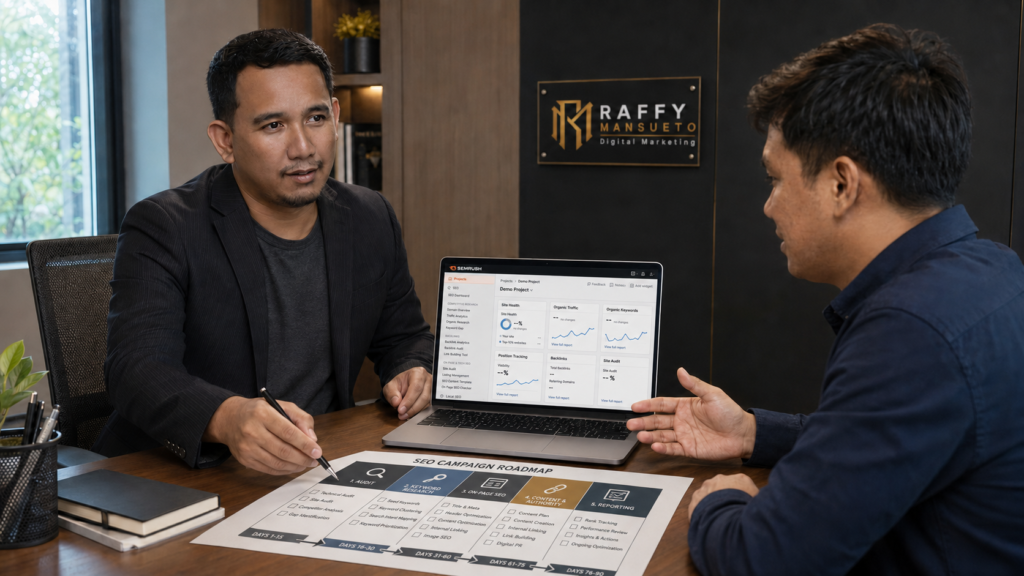
Ask what will happen during the first 30 days. A practical answer may include tracking checks, crawl and indexation review, keyword mapping, search-result analysis, content evaluation, and a prioritized roadmap. The order should reflect your website, not a generic package.
5. Evaluate the Content and AEO or GEO Approach
SEO content should answer a real need, demonstrate first-hand expertise where possible, and help a visitor make a decision. It should not be mass-produced filler built only to capture variations of the same keyword.
For AI-powered search visibility, foundational SEO remains important. Clear answers, accurate entity information, original evidence, useful images, crawlable pages, and consistent brand details help content get understood. Be wary of secret AI markup, guaranteed AI Overview inclusion, or thin content at scale.

6. Check the Link-Building and Off-Page Policy
Ask how links are evaluated and acquired. A responsible specialist prioritizes relevance, editorial value, credible directories, useful assets, and legitimate publicity. They should also explain what they will not do.
Bulk submissions, paid link networks, automated comments, hidden links, and irrelevant guest posts create risk. Request transparency about vendors, placements, anchor text, and reporting.
7. Require Reporting That Supports Decisions
An SEO report should explain what changed, what the data means, and what happens next. It may include organic clicks, impressions, relevant rankings, indexed pages, landing-page performance, conversions, completed work, and priorities.
Metrics should match the business model. A clinic may track calls, an e-commerce store may track organic revenue, and a B2B company may track qualified forms. Ask how branded and non-branded search will be separated.
8. Confirm Who Will Implement Website Changes
Some consultants provide recommendations only. Others update WordPress, Elementor, schema, redirects, navigation, forms, and internal links directly. Both models can work, but responsibilities must be clear.
If implementation is included, ask about backups, staging, approvals, quality assurance, and change logs. If your campaign also needs development, automation, or landing pages, my broader SEO and Digital Marketing Services show how those tasks can support the same search and conversion plan.
9. Compare Scope, Communication, and Business Fit
The lowest monthly fee is not always the lowest total cost. A cheap package becomes expensive when it creates unusable content, unimplemented recommendations, or harmful links. A higher proposal is not automatically better.
Compare deliverables, access, meetings, turnaround times, content ownership, cancellation terms, reporting, and exclusions. Meet the person who will manage the campaign. Clear communication and accountable execution matter more than a polished sales deck.
Freelancer, Agency, In-House, or DIY SEO?
| Hiring Model | Best For | Main Advantage | Watch-Out |
|---|---|---|---|
| Freelance SEO specialist | Small to medium businesses needing direct expertise and flexible support | Direct communication and focused ownership | Capacity and specialist coverage vary by person |
| SEO agency | Larger campaigns needing content, development, outreach, and account management | Wider team and greater production capacity | Work may pass through several layers and cost more |
| In-house SEO specialist | Organizations with continuous SEO needs and internal teams | Deep brand knowledge and daily collaboration | Salary, tools, training, and supporting resources add cost |
| DIY with consulting | Owners or marketers who can implement the work | Lower cash cost and strong internal learning | Progress may slow because of time and technical limits |
A freelance SEO specialist in the Philippines offers direct access to the person planning and implementing the work. An agency may suit campaigns requiring several specialists at high volume. Evaluate the actual scope and people involved.
How Much Does SEO Cost in the Philippines?
SEO pricing in the Philippines varies widely because “SEO” can mean a one-time audit, a few hours of consulting, local SEO for one branch, or a full campaign with technical work, content, digital PR, and website development.
The following ranges are a market-planning guide, not a quotation or an official rate card:
| Engagement | Indicative Planning Range | Common Inclusions | Important Question |
|---|---|---|---|
| Limited freelance retainer | ₱15,000 to ₱50,000+ per month | Selected on-page, technical, content, or local tasks | How many hours, pages, and implementations are included? |
| Broader agency or competitive campaign | ₱25,000 to ₱150,000+ per month | Strategy, content, technical work, outreach, and reporting | Who performs each deliverable and what is excluded? |
| One-time audit or project | Quoted by scope | Audit, migration, keyword map, or technical repair | Does the fee include implementation and verification? |
| Hourly consulting | Quoted by expertise and task | Advice, troubleshooting, training, or review | Is there a written output or action plan? |
The right budget depends on your market, website size, technical condition, content gaps, competition, number of locations, language requirements, authority, and speed of execution. Request a scope that explains the work behind the price. That makes proposals easier to compare than a package name alone.
SEO Warning Signs to Avoid
Pause before hiring if a provider:
- Guarantees a number one ranking or a fixed amount of traffic
- Claims to have a special relationship with Google
- Will not explain planned changes or provide access to completed work
- Focuses on hundreds of keywords without mapping them to useful pages
- Sells bulk links without disclosing quality, relevance, or placement methods
- Creates many near-duplicate city pages with little local value
- Uses AI to publish large volumes of unchecked, generic content
- Reports only rankings while ignoring enquiries, sales, or conversions
- Requests full website access without discussing security and permissions
- Cannot explain how success will be measured
A trustworthy SEO expert in the Philippines should explain recommendations in plain language, including their purpose, expected benefit, trade-off, and risk.
What to Prepare Before Requesting an SEO Proposal
Prepare these details for a more useful recommendation:
- Your website URL and main products or services
- Priority locations, customer groups, and markets
- Your most valuable enquiries, bookings, or sales
- Known website, indexing, ranking, or conversion problems
- Previous SEO work and any manual actions or migrations
- Available access to Search Console, GA4, WordPress, and Google Business Profile
- Internal resources for writing, development, approvals, and subject expertise
- An approximate budget range and desired engagement timeline
This helps the specialist separate urgent repairs from longer-term opportunities and propose work your team can support.
How to Measure SEO Progress After Hiring
SEO progress should be measured through a combination of completed work, search visibility, user behavior, and business outcomes. Results depend on competition, website condition, technical health, content quality, authority, budget, and consistent execution. No responsible specialist can guarantee when Google will crawl, index, or rank a specific page.
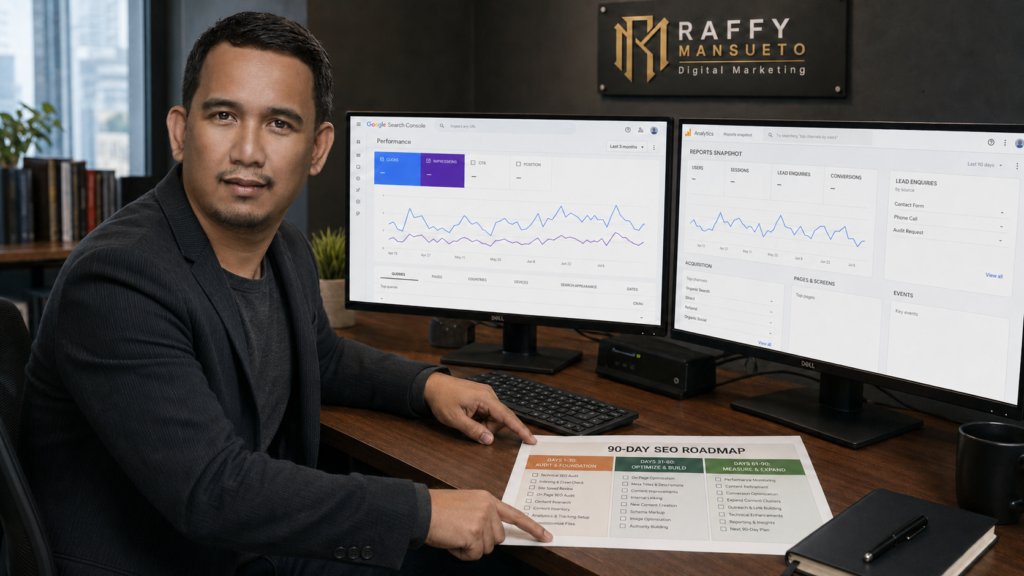
During the first 30 days, look for accurate tracking, a baseline, priorities, and early fixes. By 60 days, expect technical changes, page improvements, content, and clearer keyword mapping. By 90 days, there should be enough implementation and data to assess direction, although competitive results commonly require longer.
Review these signals together:
- Organic clicks and impressions for relevant non-branded searches
- Qualified leads, calls, bookings, sales, or revenue from organic sessions
- Visibility of priority service, product, and location pages
- Crawl, indexation, canonical, and structured-data health
- Google Business Profile visibility and actions when local SEO applies
- Engagement and conversion performance of optimized landing pages
- Work completed against the agreed roadmap
- Insights, tests, and next actions identified from the data
Frequently Asked Questions
How much does SEO cost in the Philippines?
SEO in the Philippines can range from about ₱15,000 per month for limited freelance support to ₱150,000 or more for broader, competitive campaigns. This is only a planning range. The actual cost depends on the website, number of target locations, competition, technical problems, content production, link acquisition, and whether implementation is included. Ask for an itemized scope, priorities, reporting schedule, and exclusions before comparing proposals.
How much does an SEO specialist make in the Philippines?
Current Philippine salary data places the average base pay for an SEO specialist at roughly ₱35,000 per month, but actual earnings vary substantially. Junior roles may pay less, while experienced technical, strategy, e-commerce, or international-market specialists may earn much more. Freelancers do not receive a fixed salary, so income depends on rates, client volume, specialization, operating costs, and the consistency of retained work.
Who is the best SEO specialist in the Philippines?
There is no single SEO specialist who is objectively best for every business. The right choice depends on your industry, platform, market, budget, technical needs, communication style, and whether you need advice or implementation. Compare relevant work, methods, reporting, ethical standards, and business understanding. Avoid lists that declare someone “best” without transparent criteria, verifiable evidence, or a clear explanation of fit.
How much does it cost to hire an SEO specialist?
The cost to hire an SEO specialist depends on whether you choose an employee, freelancer, consultant, or agency. A freelancer may charge hourly, by project, or through a monthly retainer. An employee also requires benefits, tools, management, and supporting resources. Instead of comparing price alone, compare the number of pages, technical fixes, content deliverables, meetings, reporting, and implementation hours included in each option.
Is it worth paying someone for SEO?
Paying for SEO can be worthwhile when search demand exists, the website can convert visitors, and the provider performs accountable work tied to business goals. SEO may be a poor investment if the offer is unclear, the business cannot serve new demand, tracking is missing, or the campaign relies on risky shortcuts. Start with an audit and realistic opportunity assessment, then invest according to expected value, competition, resources, and implementation capacity.
What are the 4 types of SEO?
The four commonly recognized types are on-page SEO, off-page SEO, technical SEO, and local SEO. On-page SEO improves content and page elements. Off-page SEO develops external authority and relevant mentions. Technical SEO supports crawling, indexing, performance, and site structure. Local SEO improves visibility for location-based searches and Google Maps. Many campaigns also use e-commerce, international, video, content, and AEO or GEO strategies.
Choose an SEO Partner Based on Fit and Execution
The right SEO specialist in the Philippines should do more than provide a keyword list or monthly report. Look for business understanding, diagnosis, prioritization, implementation, transparency, and meaningful measurement.
Start with a focused conversation about your goals, website condition, market, and available resources. If you want a practical review of your rankings, indexing, content structure, local visibility, and conversion opportunities, you can Request an SEO Audit.